Artificial Intelligence
What Is an AI Agent? A Simple Guide for New Learners
A clear, story-style introduction to AI agents, how they use Generative AI and large language models, and why they feel more like smart helpers than simple chatbots.
Khalid Rizvi · January 2026 · 6 min

An AI agent sounds fancy, but at its heart it’s just software that tries to achieve a goal for you, step by step. A normal chatbot waits for your question and gives one reply at a time. An AI agent starts from your goal—“book a bus ticket”, “summarize these documents and email my boss”, “check these logs for problems”—and works through several actions until it either finishes the job or decides it cannot. It feels less like a search box and more like a junior assistant who understands instructions, asks you follow‑up questions, and actually does things on your behalf.
An AI agent is a goal‑driven assistant, not just a question‑answering chatbot.
To do this, the agent needs a “brain.” In modern systems, that brain is usually a large language model (LLM)—a type of Generative AI that is very good at reading, writing, and reasoning with text and code. The LLM reads your request, interprets what you want, and decides what to do next: whether to call an external tool, ask you for clarification, search some data, or produce a direct answer. On its own, an LLM is just a powerful text engine. When you place it inside an agent, add memory, tools, and rules, the LLM becomes the thinking component driving the whole process.
Generative AI and LLMs provide the brain; the agent wraps that brain with tools, memory, and goals.
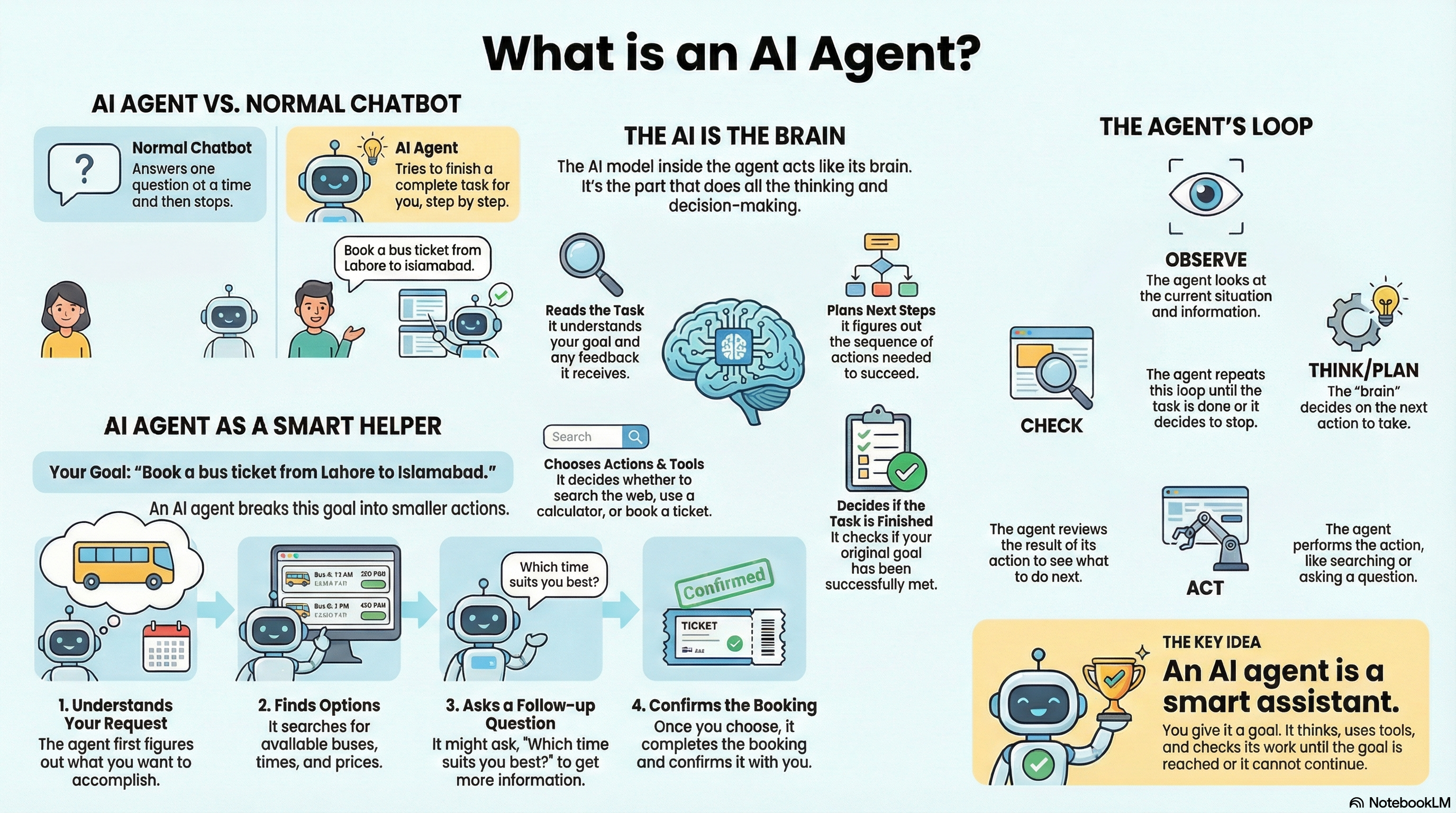
The infographic’s bus‑ticket example captures this nicely. You say, “Book a bus ticket from Lahore to Islamabad tomorrow evening.” The agent first understands your request, then looks up available buses, then maybe asks which time you prefer, and finally confirms the booking. Each of these steps may involve different tools—an API for schedules, a payment system, a calendar—but the agent, guided by the LLM, keeps track of your goal from start to finish. You are not micro‑managing every click; you’re just stating what you want and answering occasional clarifying questions.
Instead of you managing each step, the agent breaks your goal into smaller actions and drives them to completion.
Under the hood, an AI agent usually follows a repeating loop: it observes the current situation, thinks and plans, acts, and then checks the result. It observes by reading your latest message and any tool outputs; it thinks by using the LLM to decide the next step; it acts by calling a tool or replying; and it checks whether that action moved it closer to the goal. Then it goes back to observing. This loop runs multiple times during a single “task”—for example, searching, then filtering results, then asking you to choose, then executing the final action.
The agent works in a cycle: observe → think/plan → act → check, repeating until the goal is done or it must stop.
Generative AI and LLMs fit into this loop as the reasoning engine. Generative AI means models that can produce new content; LLMs are a specific kind of generative model specialized in language. The agent uses an LLM to understand instructions, generate text, and reason about tool outputs. But the agent itself is larger than the LLM: it knows what tools exist, what the goal is, how to store and recall intermediate information, and when to stop. You can swap one LLM for another, and the agent’s overall behavior—its loop and tools—can remain mostly the same.
An AI agent is “LLM + tools + memory + control loop,” all organized around a user’s goal.
This separation is important because it explains why agents are powerful and also why they must be designed carefully. The LLM is flexible and creative, but it can also be wrong or vague; the agent layer adds structure, guardrails, and the ability to connect to real systems. When you hear about agents automating workflows, calling APIs, or operating in closed networks, that’s really the agent using the LLM’s brain while enforcing rules and using the right tools for each step.
LLMs make agents smart; the agent framework makes them useful, controllable, and safe enough for real tasks.