Artificial Intelligence
RAG with Tabular Data: From Schemas to Answers
How to design and operate Retrieval-Augmented Generation systems over relational and financial tabular data.
Khalid Rizvi · January 2026 · 12 min

Since you already understand text-centric RAG, we can skip the usual explanations around embeddings, chunking, and cosine similarity. Instead, this article focuses on the architectural, logical, and operational shifts required when applying Retrieval-Augmented Generation to structured, relational data.
Unlike document RAG, tabular RAG is not about “finding relevant text.” It is about producing numerically correct, auditable answers from rigid schemas—without sacrificing the flexibility of natural language.
Tabular RAG vs. Document RAG
The most important mindset shift is understanding what “retrieval” means in each system.
Document RAG retrieves information—text chunks that the LLM reads and reasons over.
Tabular RAG retrieves answers—or tightly scoped subsets of rows—derived through computation.
This difference drives every architectural decision.
Schema Awareness and Joins
In text RAG, context is often self-contained within a chunk. In tabular systems, context is distributed across normalized tables. The retrieval layer must understand relationships such as foreign keys and join paths.
A question like:
“What are total sales per region last quarter?”
may require joining orders, customers, and regions, followed by grouping and aggregation. The system must reason over schema topology, not just content similarity.
Logic Pushdown (The Most Critical Difference)
In document RAG, reasoning happens after retrieval. In tabular RAG, reasoning must happen inside the database.
LLMs are fundamentally unreliable at arithmetic over large datasets. Databases are exceptionally good at it. Therefore, aggregations (SUM, AVG, COUNT), filters, joins, and time windows must be pushed down into SQL.
A correct architecture treats the LLM as a planner and translator—not a calculator.
Numeric and Time Reasoning
Document RAG relies on semantic similarity. Tabular RAG relies on exactness.
Fuzzy phrases like “last week,” “top customers,” or “recent activity” must be translated into precise SQL predicates such as:
timestamp >= NOW() - INTERVAL '7 days'
Core Architectural Components
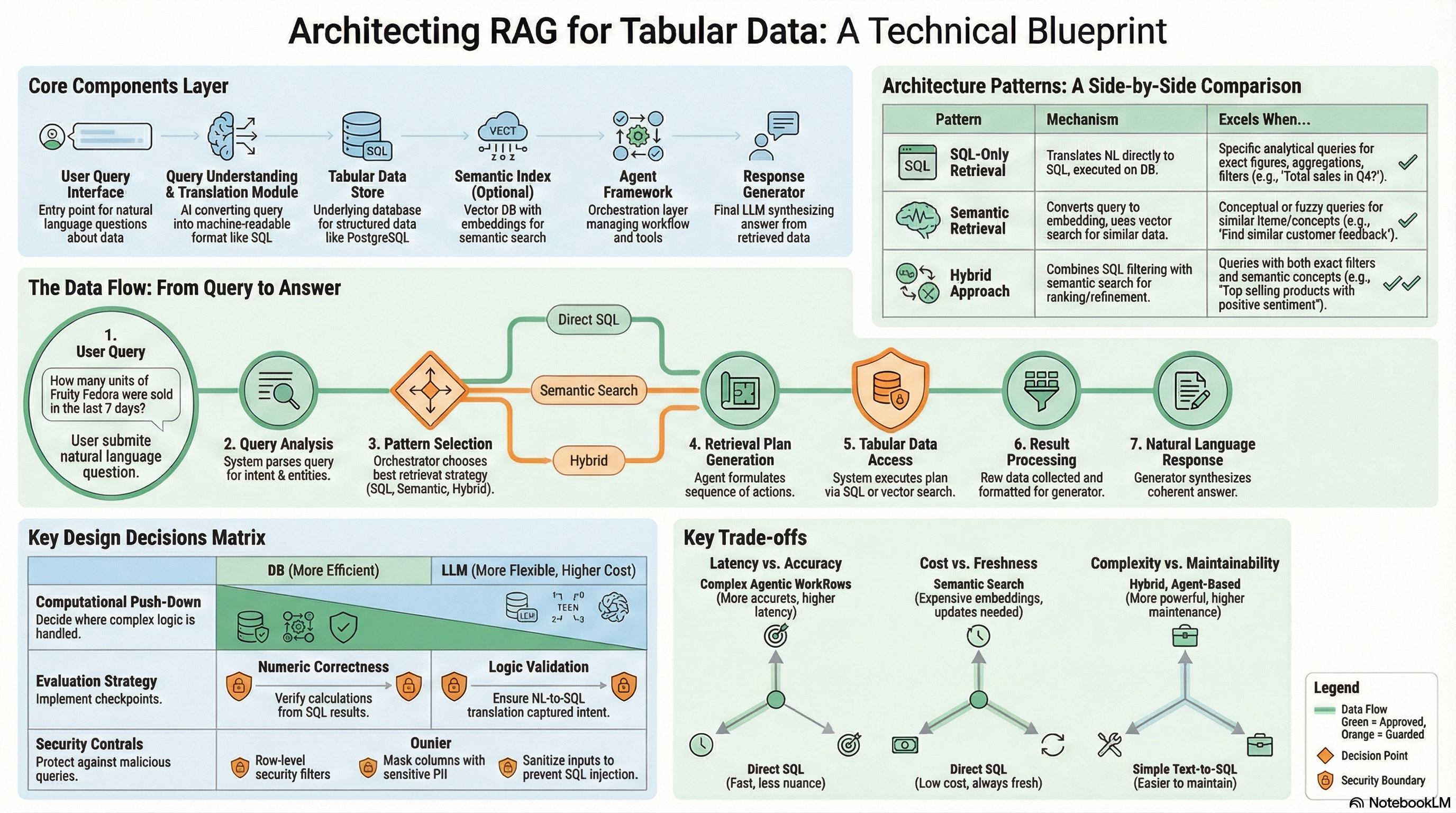
From natural language to numerically correct answers—this blueprint shows how RAG, SQL, and semantics work together to turn schemas into insight.
The infographic’s top layer highlights a clean separation of concerns that is essential for production systems.
User Query Interface
This is the raw natural language entry point. It should capture intent without prematurely forcing structure.
Query Understanding & Translation
This layer extracts:
- Intent (aggregation, comparison, lookup)
- Entities (metrics, time ranges, dimensions)
- Ambiguity signals
Importantly, it does not always produce SQL immediately. Sometimes it produces partial structure used by an orchestration layer.
Tabular Data Store
This is the source of truth: PostgreSQL, Snowflake, BigQuery, etc. All numerical correctness must originate here.
Semantic Index (Optional but Strategic)
Embeddings are useful when applied selectively:
- Free-text columns
- Descriptions
- User feedback or comments
Embedding entire tables blindly is expensive and usually unnecessary. The diagram correctly positions semantic indexing as optional—not foundational.
Agent / Orchestration Layer
This is the control plane. It decides:
- SQL-only
- Semantic retrieval
- Hybrid execution
It also manages retries, validation loops, and execution order.
Response Generator
The final layer converts structured results into clear explanations. It should never invent numbers—only explain retrieved facts.
Core Retrieval Patterns
The infographic shows three dominant patterns used in real systems.
1. SQL-Only (Text-to-SQL)
Here, the LLM acts as a semantic parser. The “retrieval” is SQL execution, and the “context” is the schema.
Best suited for:
- Dashboards
- BI queries
- Aggregations and metrics
This path is fast, cheap, and reliable when queries are well-defined.
2. Semantic Retrieval over Rows (Hybrid)
In this pattern, vectors are generated for rows or selected columns (by serializing them into text). Vector search retrieves relevant rows, which are then filtered or ranked.
Best for:
- “Find similar complaints”
- “Show transactions related to fraud”
- Needle-in-a-haystack searches
3. Feature-Store–Style Routing
An intelligent router decides whether to:
- Query a feature store for pre-computed metrics
- Generate ad-hoc SQL for exploratory analysis
This pattern is common in real-time and fintech systems.
End-to-End Data Flow: From Question to Answer
The center of the diagram shows the full execution pipeline:
- User Query Natural language input enters the system.
- Query Analysis Intent, entities, and ambiguity are extracted.
- Pattern Selection (Decision Point) The agent chooses SQL-only, semantic, or hybrid execution.
- Retrieval Plan Generation A concrete plan is built: SQL statements, vector queries, validation steps.
- Tabular Data Access Execution occurs against secured data sources.
- Result Processing Raw rows are transformed into structured summaries.
- Natural Language Response The system explains results clearly and accurately.
Skipping or collapsing these steps is the fastest way to build a brittle system.
Key Design Decisions and Guardrails
Computational Pushdown
Always push computation to the database. Let LLMs plan; let databases compute.
Evaluation Strategy
Two validations are mandatory:
- Numeric correctness: results must match SQL output
- Logical correctness: translation must reflect user intent
Reliability Guardrails
LLMs hallucinate column names. Protect against this with:
- Error-feedback correction loops
- Schema-constrained generation
- Typed outputs (e.g., Pydantic models)
Security Controls
Security cannot live in prompts.
- Enforce Row-Level Security (RLS) in the database
- Use read-only credentials
- Mask PII at the view level
- Sanitize all generated SQL
Trade-offs: Designing with Eyes Open
The infographic makes the trade-offs explicit:
-
Latency vs. Accuracy Hybrid and agentic workflows are slower but more accurate.
-
Cost vs. Freshness Semantic indexes cost money and require updates. SQL is always fresh.
-
Complexity vs. Maintainability Simple text-to-SQL is easy to maintain but fragile. Hybrid systems are powerful but demand discipline.