Artificial Intelligence
Compliant AI Orchestration in Insurance: From API Calls to Structured Claim Decisions
A practical guide to building a stateful, agent-driven insurance workflow that orchestrates eligibility checks, contract validation, shared state management, human oversight, and data-grounded claim summaries.
Khalid Rizvi · February 2026 · 8 min

This sketch tells the story of how an AI “claims co-worker” can move beyond answering questions and begin doing meaningful work inside an insurance operation. Instead of functioning as a chatbot on the sidelines, the AI becomes an active participant in the claims process—verifying coverage, checking contracts, and helping drive decisions forward.
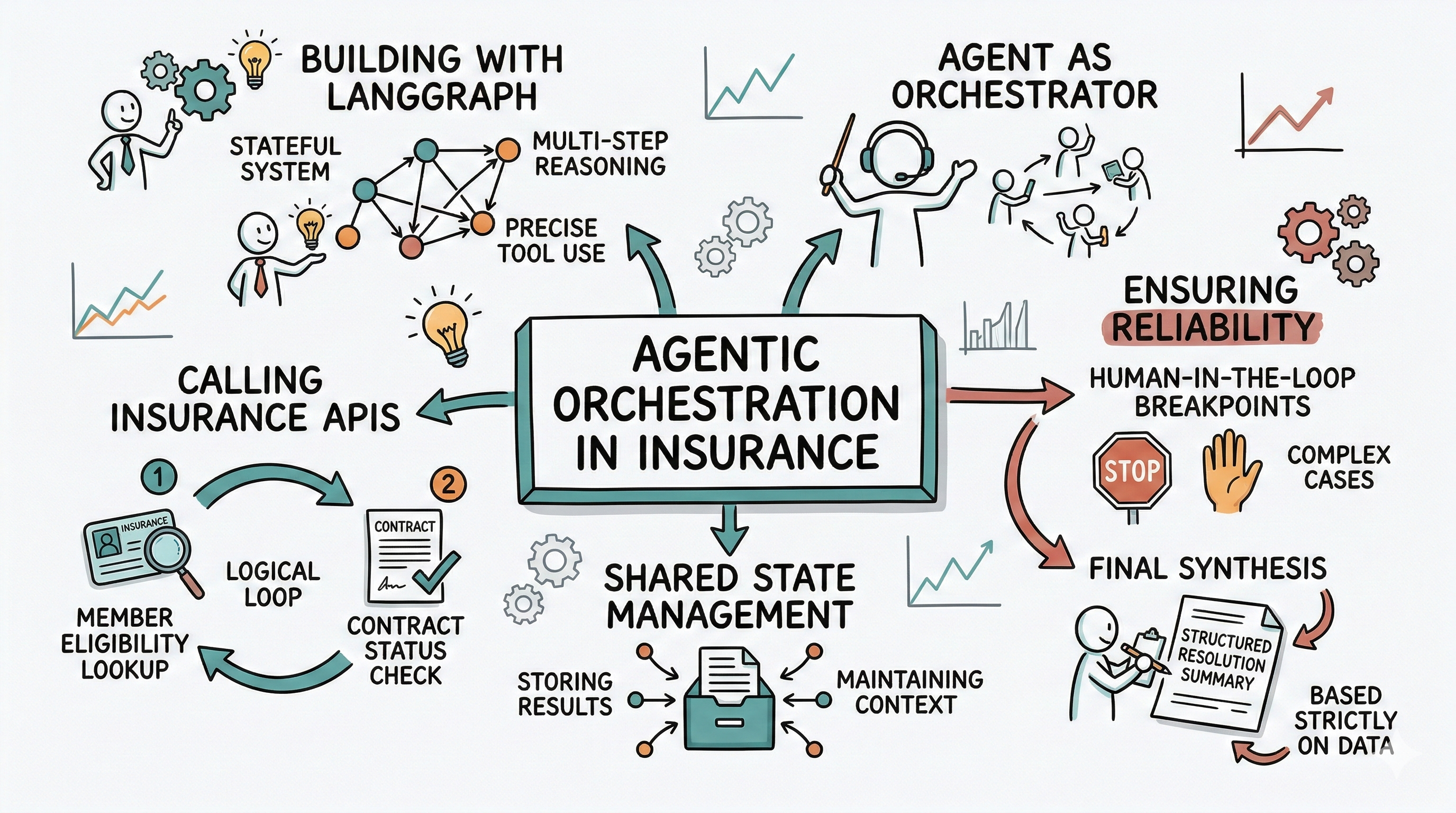
What this image illustrates is not simply an AI responding to prompts, but an AI system coordinating an entire insurance workflow from start to finish. The central idea is orchestration. In practical terms, orchestration means managing a sequence of dependent tasks—calling the right systems in the right order, storing results, and using each outcome to determine the next step—so that a claim or inquiry progresses in a controlled, auditable, and compliant manner.
At the center of the diagram is “Agentic Orchestration in Insurance.” The agent is not just generating text. It is acting as an orchestrator, much like a conductor leading an orchestra. Each internal insurance system—eligibility databases, contract management systems, claims platforms—represents a different instrument. The orchestrator decides which system to query, when to query it, and how to use the response. The outcome is a coordinated process rather than a collection of disconnected API calls.
The top-left portion of the image refers to building this with a stateful system using a framework such as LangGraph. The key idea here is statefulness. A stateful workflow remembers what has already happened. If the agent checks member eligibility and learns that a policy is active, that fact is stored. When it later checks contract status or benefit limits, it does not need to rediscover who the member is or what plan they are on. The system maintains a shared state—effectively a living case file that accumulates facts as the workflow progresses.
This enables multi-step reasoning. Instead of answering a single question in isolation, the agent follows a structured sequence. For example, when processing a claim, it may first verify member eligibility. If the member is inactive, the workflow can stop immediately. If the member is active, the agent proceeds to check provider contract status. If the provider is out of network, the reimbursement logic changes. Each decision depends on the results of the previous step. The reasoning unfolds across multiple stages, with each step grounded in retrieved data rather than assumptions.
The diagram’s “Calling Insurance APIs” section shows this logical loop. The agent calls specific, predefined APIs—such as a member eligibility lookup or a contract status check. The loop is important because insurance logic is rarely linear. If a contract check returns ambiguous information, the agent may need to make another call to clarify coverage tier, referral requirements, or prior authorization status. The system can iterate within defined boundaries until it gathers sufficient information to proceed. This is controlled, rule-based looping, not open-ended speculation.
All of these results flow into shared state management. This is the backbone of the orchestration model. Every API response is stored in a structured format. That stored information becomes the context for subsequent decisions. By maintaining a central state object, the system ensures that all downstream actions are based on the same verified data. This reduces inconsistency and avoids redundant calls. It also creates an audit trail: one can trace which systems were queried, what they returned, and how those results influenced the final outcome.
The top-right portion of the image emphasizes the agent as orchestrator. This reinforces that the agent’s primary function is coordination. It does not replace core systems; it sequences and integrates them. It follows predefined business rules, routes cases down different paths depending on data, and determines when the workflow is complete. This orchestration layer effectively sits above existing infrastructure and makes it behave as a unified process.
Reliability and compliance are addressed explicitly in the “Ensuring Reliability” section. In insurance, full automation without oversight can create risk, especially for high-value or complex claims. The diagram includes human-in-the-loop breakpoints. These are deliberate pauses in the workflow where the system stops and hands control to a human reviewer. For example, if a claim involves unusual coding patterns, large dollar amounts, or conflicting eligibility data, the orchestrator can flag the case and escalate it. The human reviewer sees the complete shared state, including every API response and reasoning step, and can make an informed decision. This design preserves accountability and supports regulatory compliance.
Finally, the workflow ends with a final synthesis step. After all required checks are complete and any necessary human review has occurred, the agent compiles a structured resolution summary. This summary is based strictly on the retrieved and stored data. It does not invent facts. Instead, it references verified eligibility status, contract terms, benefit rules, and any human annotations. The result is a clear, standardized explanation of how the decision was reached. This is valuable both operationally, for internal staff, and externally, for member communications or audit requirements.
When viewed as a whole, the flow depicted in the image represents a disciplined approach to AI in insurance. The system begins with a claim or inquiry, uses a stateful workflow to plan and execute multiple steps, calls authoritative internal APIs in a controlled loop, stores all findings in a shared state, escalates complex cases to humans when needed, and concludes with a structured, data-grounded summary. Orchestration, in this context, is the disciplined coordination of systems, logic, and human oversight to produce consistent, compliant outcomes.
Parting thoughts
When implemented thoughtfully, this orchestration model gives insurers something powerful: controlled automation. The agent does not replace systems or people. It sequences existing systems intelligently, preserves context across steps, documents every decision point, and escalates when human judgment is required. The result is faster processing for straightforward cases, tighter compliance controls for complex ones, and a transparent audit trail throughout. That combination—efficiency, accountability, and data-grounded reasoning—is what makes agentic orchestration particularly well-suited for regulated environments like insurance.
If you are exploring how to implement compliant, stateful AI orchestration within your insurance workflows, I would welcome the opportunity to speak with you. Feel free to reach out directly at [email protected] or call me to discuss your specific use case and how this approach can be tailored to your organization’s operational and regulatory requirements.