Artificial Intelligence
Building True AI Agents: Understanding the Core Architecture
A clear, layer-by-layer explanation of how modern AI agents are constructed — from probabilistic token prediction to structured tool use, strong typing, and observable orchestration loops.
Khalid Rizvi · February 2026 · 10 min

The leap from powerful language models to genuinely capable AI agents is one of the most important shifts happening in artificial intelligence right now. Agents are systems that don’t just answer questions — they pursue goals, make decisions, call tools, observe results, and adapt over multiple steps.
The diagram we’re looking at (originally generated in NotebookLM after borrowing concepts from various sources) lays out the essential pieces of this architecture in a single, dense visual. Let’s walk through it thoughtfully and see what it actually tells us about how modern agentic systems are designed.
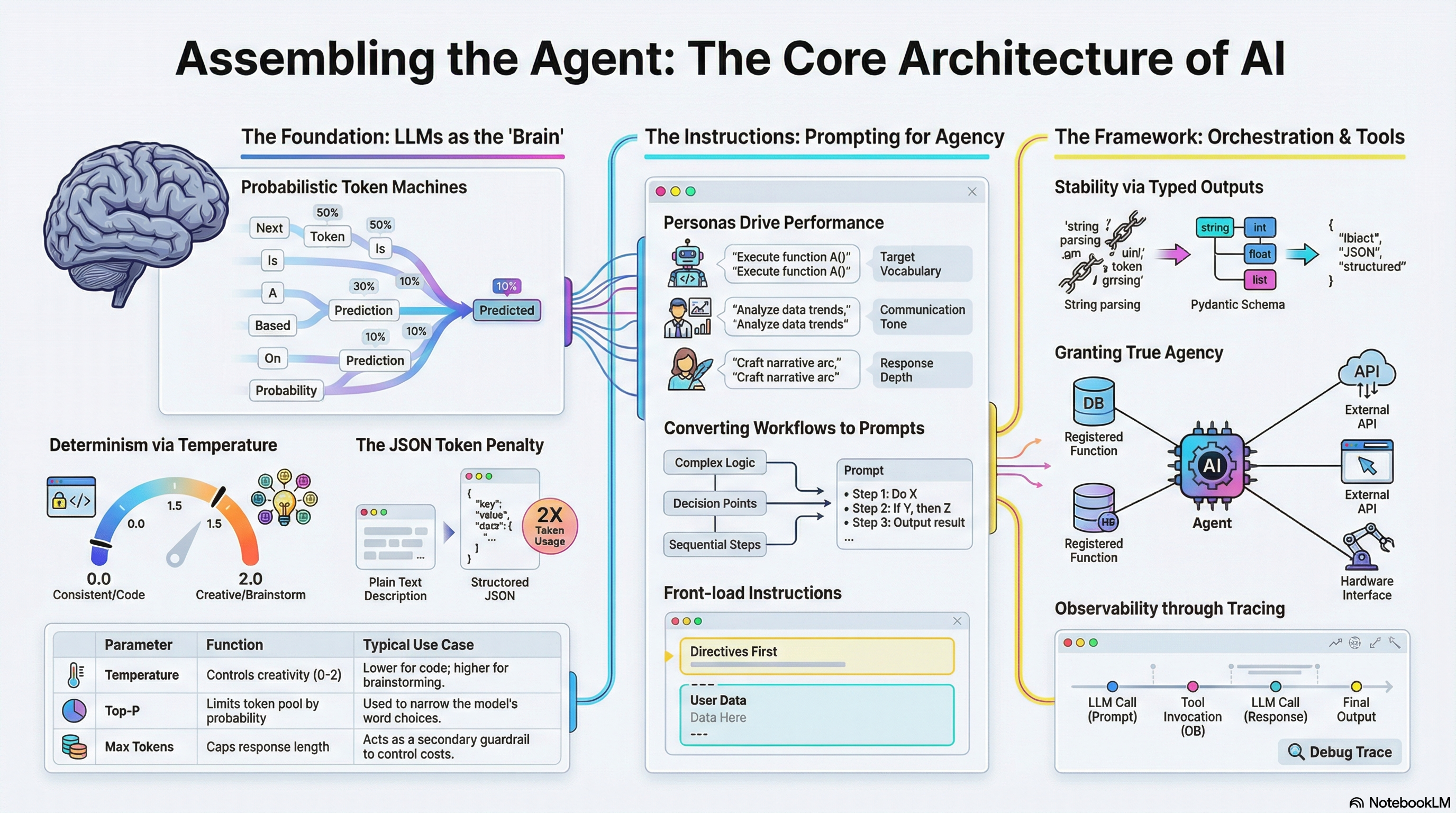
1. The Foundation: Language Models Are Probabilistic Token Predictors
Everything starts with the large language model itself — represented here as a stylized brain.
At its core, an LLM is a machine that predicts the next token in a sequence. Each prediction carries a probability distribution: maybe 32% chance the next word is “is”, 18% “was”, 11% “has”, and so on. The model samples (or picks the most likely token) from that distribution repeatedly to generate text.
Two controls fundamentally shape how reliable or creative that process becomes:
-
Temperature
Low temperature (0.0–0.7) → almost deterministic behavior. Outputs become consistent, repeatable, suitable for code, structured data, or precise reasoning.
High temperature (1.2–2.0) → much more diverse, exploratory, sometimes erratic outputs. Useful for creative writing or ideation, but rarely for agents. -
JSON / structured output enforcement
Modern models can be heavily biased toward producing valid JSON by penalizing any token that would break the structure. This seemingly small trick increases reliability by 5–20× in many agent pipelines because downstream code can now reliably parse the model’s answer instead of hoping regex or fuzzy parsing works.
This probabilistic core is both the strength and the limitation of today’s agents: we are always managing uncertainty.
2. The Instructions Layer: Turning a Predictor into a Reasoner and Planner
The middle section of the diagram focuses on prompt engineering techniques that create agency.
Three ideas stand out:
Personas and role instructions
Giving the model a consistent identity (“You are a methodical senior DevOps engineer”, “You are an analytical financial strategist”) dramatically improves task performance. The persona sets vocabulary, reasoning style, risk tolerance, and level of verbosity. It is one of the highest-leverage prompt techniques that still exists in 2025–2026.
Workflows expressed as explicit steps
Rather than asking the model to “solve this problem”, the best agent prompts break the task into ordered stages:
- Step 1: Gather required information
- Step 2: Evaluate against criteria A, B, C
- Step 3: If condition X, execute path Y; else path Z
- Step 4: Format final output using this exact schema
This turns an otherwise open-ended generation task into something much closer to a controlled procedure.
Front-loading critical context
Placing the most important instructions, user preferences, and constraints at the very beginning of the prompt consistently produces better results than burying them later. Models pay disproportionate attention to early tokens.
Together, these prompting patterns are what allow a stateless next-token predictor to behave like it has memory, goals, and self-correction — at least for the duration of one long context window.
3. The Execution Framework: Tools, Structured Outputs, and Traceability
The right side of the diagram shows how we move from thinking to acting.
Key elements:
Strongly typed outputs (Pydantic, JSON Schema, etc.)
Instead of hoping the model returns something parseable, we force structured output (usually JSON) and validate it against a predefined schema. If validation fails, many systems automatically retry with stronger instructions or fall back to a repair step. This is the single biggest practical improvement in agent reliability over the past two years.
Tool / function calling
Agents register external capabilities — database queries, web searches, file operations, third-party APIs, math engines, even physical hardware interfaces. The model decides when and how to use them by emitting structured function calls.
Observability through tracing
Serious agent systems log every step:
- prompt that was sent
- model response
- tool call arguments
- tool execution result
- next prompt (including previous observations)
Without this trace, debugging why an agent failed at step 17 becomes nearly impossible.
What the Diagram Is Really Saying
If you step back, the entire flow can be summarized in four words:
Predict → Instruct → Structure → Orchestrate
- Predict: raw LLM token generation
- Instruct: shape behavior through personas and step-by-step reasoning
- Structure: force machine-readable, reliable outputs
- Orchestrate: give the system memory (via history), tools, and long-running control flow
Only when all four layers work together do you get something that deserves to be called an “agent” rather than a very clever chatbot.
Final Thought
Agent architectures are not mysterious. They are the deliberate combination of statistical prediction, careful linguistic control, rigid output formatting, and disciplined execution loops.
The most capable agents today are not the ones with the biggest model — they are the ones where engineers have most thoughtfully engineered all four of these layers.
The diagram we started with is dense, but it is honest. It shows exactly where the real engineering work happens.
If you’re building agents, keep returning to this map. Almost every meaningful improvement you can make lives somewhere inside these three columns.