Artificial Intelligence
Architecting an Agentic Claims Assistant: A Simple, Grounded Explanation of Autonomous Insurance Triage
A step-by-step, plain-language walkthrough of how to design a stateful, tool-using AI claims assistant using LangGraph — covering orchestration, shared state, multi-step reasoning, human-in-the-loop controls, and structured resolution outputs.
Khalid Rizvi · February 2026 · 12 min

Let us begin with a very simple question.
What is an Agentic Claims Assistant?
Imagine a very smart insurance employee who can read a new claim, decide what checks are required, call the right internal systems, gather the results, and prepare a clean summary for a human processor — all automatically. But unlike a basic chatbot, this assistant does not just “talk.” It thinks step by step. It uses tools. It remembers what it has already learned. And when something goes wrong, it pauses and asks a human for help.
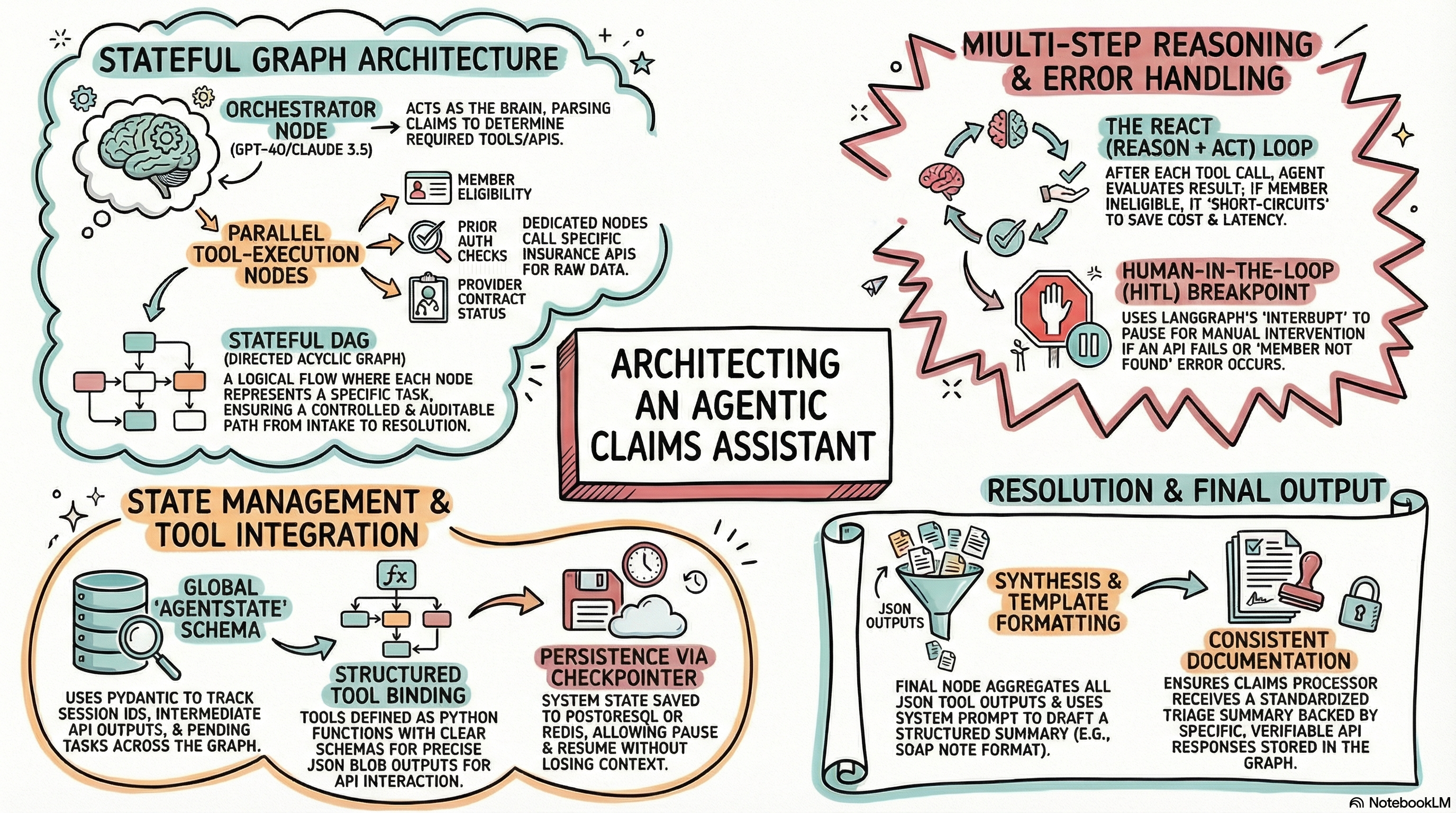
That is what this architecture represents.
This system is built using something called LangGraph, which allows us to design AI systems as structured workflows with memory and control. Instead of one big black-box response, we build a flow of clear steps. Each step has a purpose. Each step is traceable.
Now let us walk through the entire image slowly and clearly, as if we are explaining it to someone seeing this idea for the first time.
1. Stateful Graph Architecture — The Brain of the System
At the heart of the system is what we call a stateful graph architecture.
Do not let the words scare you.
A graph here simply means a flowchart of steps. Stateful means the system remembers what has happened so far.
So instead of starting from scratch every time, the assistant carries a “case file” in memory while it works.
The Orchestrator Node — The Brain
The first major piece is the Orchestrator Node.
Think of this as the brain.
When a claim comes in, the orchestrator reads it carefully. It tries to understand:
- What type of service is this?
- Which member is involved?
- Which provider is involved?
- What checks are required?
It does not immediately generate a final answer. Instead, it decides which tools it must use.
In this case, the tools are insurance APIs such as:
- Member eligibility check
- Prior authorization verification
- Provider contract status
The orchestrator does not perform these checks itself. It decides which ones need to be called.
Tool-Execution Nodes — The Workers
Each insurance check is handled by a dedicated node.
For example:
- Member_Eligibility_API verifies if the member was covered on the date of service.
- Prior_Auth_Check verifies if authorization was required and approved.
- Provider_Contract_Status checks if the provider is in-network or out-of-network.
Each of these nodes performs one specific task.
This makes the system clean and auditable. Every node has a single responsibility.
Parallel Tool Execution
Sometimes multiple checks can happen at the same time.
For example, eligibility and provider contract status do not depend on each other. So they can run in parallel, which saves time.
This is similar to having multiple employees working on different parts of a file simultaneously.
Stateful DAG — A Controlled Flow
The system is structured as a Directed Acyclic Graph (DAG).
In plain terms, that means:
The process flows forward step by step in a logical order. It does not randomly jump around.
Every step is controlled. Every path is defined. Every transition is traceable.
This ensures that from claim intake to final summary, the process is consistent and auditable.
2. State Management & Tool Integration — The Memory System
Now let us talk about something extremely important: memory.
If the system calls three APIs, it must remember the results of each one.
That memory is stored in something called a global AgentState.
Think of this as a structured digital folder that contains:
- claim_id — the unique ID for this case
- intermediate_outputs — results from each API
- pending_tasks — tools that still need to be called
This structured state is managed using Pydantic, which ensures that the stored data follows a strict format. That prevents messy or inconsistent data.
Tool Binding — How the AI Calls APIs
The AI does not randomly call APIs.
Instead, tools are defined as structured functions with clear schemas. The model outputs a structured JSON instruction such as:
“Call Member_Eligibility_API with member_id = 12345 and service_date = 2026-02-01.”
This makes tool usage precise and machine-readable.
The AI is not free-typing API calls. It is generating structured instructions.
That is what makes this system reliable.
3. Multi-Step Reasoning & Error Handling — Thinking Step by Step
Now we come to one of the most powerful parts of the system.
The assistant does not do everything at once.
It follows a loop called ReAct — Reason + Act.
Here is how it works:
- The orchestrator reasons about what needs to be done.
- It calls a tool.
- The tool returns a result.
- The result is stored in state.
- The orchestrator reasons again based on new information.
For example:
If the eligibility API says the member is inactive, the system immediately stops further checks.
Why check provider contracts if the member has no coverage?
This is called short-circuiting. It saves time and cost.
Error Handling & Human-in-the-Loop
Real-world systems fail sometimes.
An API might return a 500 error. A member ID might not be found.
When that happens, the system does not guess.
Instead, it triggers a Human-in-the-Loop breakpoint.
Using LangGraph’s interrupt feature, the system pauses. The current state is saved into a database (PostgreSQL or Redis).
A human processor can then:
- Fix missing data
- Clarify ambiguous information
- Override incorrect results
After human input, the agent resumes from exactly where it left off.
This ensures the system is autonomous — but never uncontrolled.
4. Persistence — Never Losing Context
Because the state is saved in a checkpointer, the system can:
- Pause
- Resume
- Recover from failure
Without losing context.
In insurance, that is critical. Claims can span hours or days. You cannot afford to lose progress.
5. Resolution & Final Output — Clean, Structured Documentation
After all checks are completed, the final node aggregates everything.
It looks at:
- Eligibility result
- Authorization status
- Contract status
- Any human inputs
Then it uses a predefined system prompt to generate a structured output such as:
- Claim Triage Summary
- SOAP note
- Standardized resolution document
The key idea here is consistency.
Every processor receives the same structured format.
The summary is not random text. It is grounded in the specific API responses stored in state.
This makes it defensible and auditable.
What Is This All About?
Let us step back.
This is not about building a chatbot for insurance.
This is about building an autonomous but controlled digital claims assistant.
It can:
- Read incoming claims
- Decide which checks are needed
- Call insurance systems
- Store results
- Stop early when necessary
- Escalate to humans when needed
- Produce standardized documentation
All while maintaining full traceability.
Why This Matters for Insurance and Beyond
In insurance — especially in areas like Property & Casualty — claims decisions must be consistent and defensible.
In healthcare insurance, eligibility and authorization mistakes can be costly.
In banking, similar architectures can automate loan checks or fraud investigations.
In all regulated industries, the key requirements are:
- Structured workflow
- Clear audit trail
- Controlled tool usage
- Human oversight
- Standardized output
This architecture delivers exactly that.
It turns AI from a chat tool into a structured decision-support system.
And that is the real transformation.
Not smarter text.
Smarter workflows.